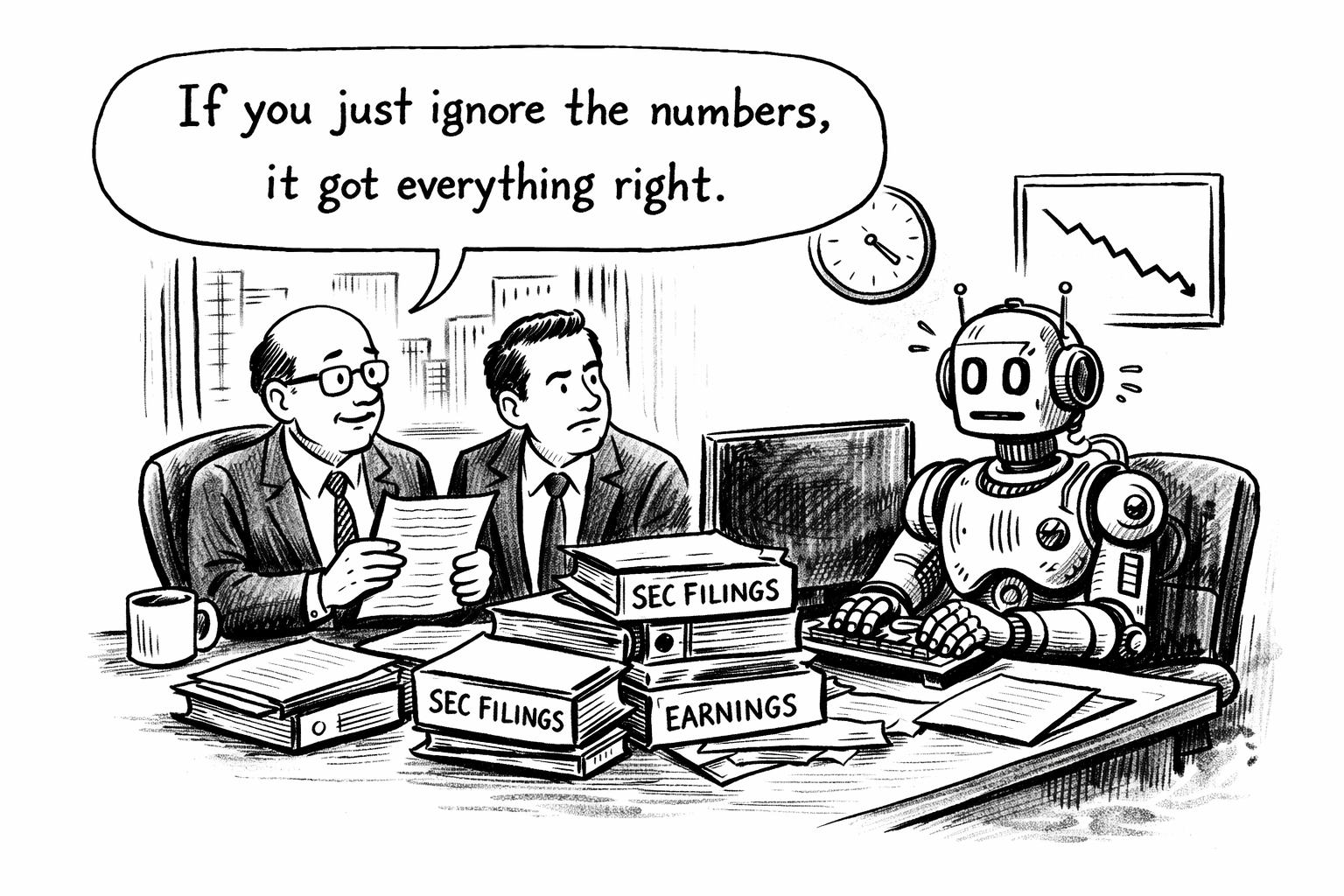
If you see a large enterprise touting an extraordinary new AI application in the press, you can safely assume that internal, real AI adoption is low. We frequently have the opportunity to see firsthand the discrepancy between what’s being said and what’s being done. For many enterprises, that gap is wide.
The firms that are really winning the AI race are doing it quietly.
The Accidental Effect of AI: Better Boring Software
One of the most valuable uses of AI today is writing code. It’s one application that nearly everyone agrees is effective. As a result, software is getting better faster than at any point in the last two decades. Features that once took months to build now appear in days. Niche tools that would never have justified venture funding five years ago are now viable, cheap, and surprisingly robust.
Some great new software is explicitly AI-driven, like Hudson Labs. Some of it is not. In practice, this distinction is often irrelevant. What matters is that the tools work.
The fixation on “AI adoption” confuses the real question: what work should humans no longer be doing? Many of the answers have existed for years in the form of automation tools, scripting layers, workflow software, and integration. AI has lowered the cost and expanded the surface area.
Reliability Beats Brilliance
Finance influencers frequently suggest using AI to create an end-to-end thesis for a stock. But in the next breath, they warn against using AI to pull financial metrics.
If you don’t believe that your AI software can access and assess the most basic information needed to evaluate a stock (fundamental and market metrics), why would you believe the ultimate recommendation is correct?
One reason we believe AI is better at creative tasks is that when there isn’t one correct answer to compare against, it’s easier to ascribe brilliance to a bot.
AI offers the highest return on investment for well-defined tasks where correctness can be measured, rather than imagined.
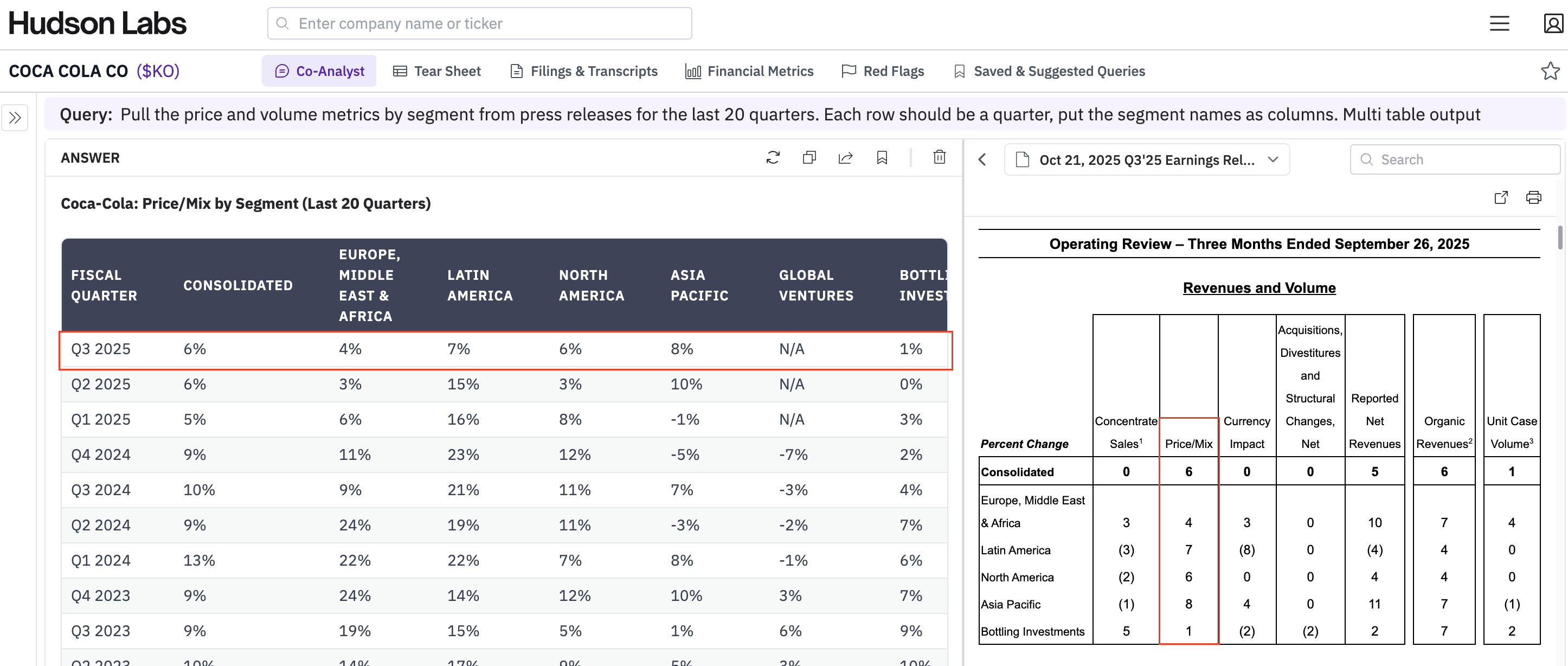
One of the most popular uses of the Hudson Labs Co-Analyst is very simple: using AI to reliably and accurately pull financial and operating metric trends directly from source documents (calls, press releases, and 10-Ks), regardless of how the numbers were originally disclosed.
In this situation, the benefits are clear: hours of work saved, accuracy easily verified, and human judgment preserved. Here are 15 other concrete examples of narrow but high-impact AI uses in investing and real life.
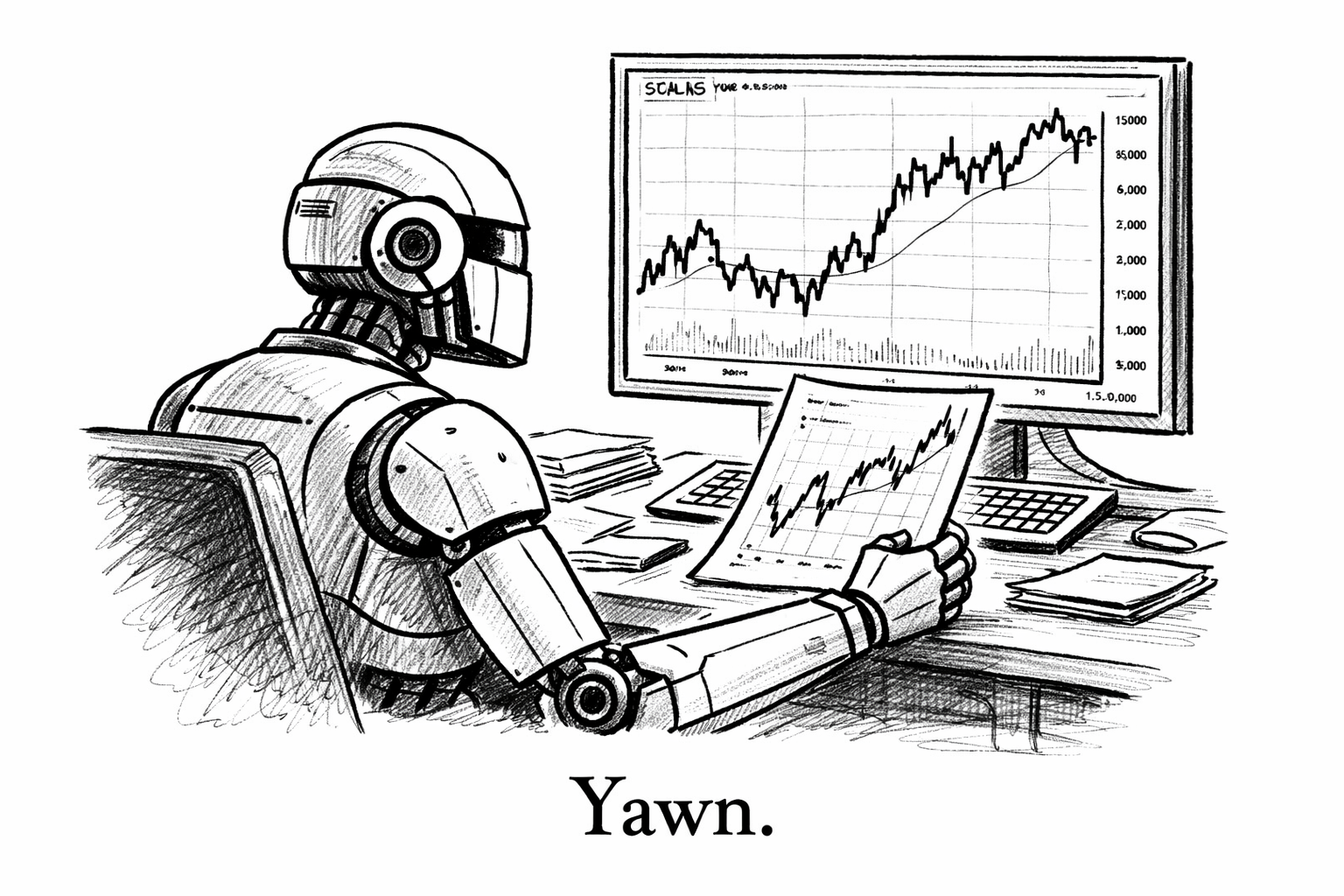
The firms that get the most value will use AI where it removes time-consuming drudgery, not where it substitutes for thinking.
Small Players Benefit Disproportionately
One of the underappreciated effects of AI is that its benefits accrue disproportionately to smaller teams. Large organizations face more friction: procurement, compliance, legacy systems, and internal politics.
Smaller firms can experiment faster and discard failures quickly. For small teams, the incentive to save time is higher. When budgets are constrained, the value of replacing even a fraction of a human workflow is obvious.
Anecdotally, the teams we work with that have the most advanced AI usage are hedge funds with fewer than 10 people. Large asset managers, big banks, and corporate enterprises—with large AI development teams and high AI spend—paradoxically often demonstrate the lowest AI adoption among actual users.
The Dark Side of Internal AI Builds
It turns out that excellent AI development is hard. Despite the incredible progress of the last few years, constantly evolving edge cases, accuracy failures, and usability quirks make productization crucial.
Models change so quickly and tooling evolves so rapidly that the maintenance burden of large internal AI builds becomes overwhelming. As a result, most custom-built solutions quickly fall behind the state of the art.
Many internal teams were also misled about the value of training on internal datasets. Proprietary training data was viewed as the only way to build a model with a durable edge.
This advice could not have been more wrong. In-house proprietary training data is not a competitive advantage in the age of AI. With few-shot prompting, someone can achieve similar quality results with four examples as they would with four thousand.
Every Team Needs Technical Capacity
To take advantage of modern software—AI-powered or otherwise—you need people who understand what is possible and how systems fit together. Just because your team isn’t building AI models from scratch doesn’t mean you don’t need technical capacity.
We’ve entered the age of integration and automation. It has never been easier to make disparate systems talk to each other. This creates a unique opportunity to build semi-custom workflow solutions tailored to your team.
Fortunately, you don’t need to hire an AI engineer from Meta for $100M. You simply need someone who understands APIs, data formats, and basic coding. (Note: it has never been easier to learn to code, so this capacity can be developed in-house.)
How to Win the AI Wars in 2026
Winning organizations will:
- Create basic technical capacity. Tip: hire a front-end developer recently laid off from a high-end tech role, or invest in training technically minded members of your existing team.
- Make a few uncomfortable decisions to increase the speed of software adoption: Give employees individual software budgets; allow experimentation without prior approval; streamline compliance, and accept manageable risk.
- Prioritize hiring and promoting people who are excited to learn new software and adapt their workflows as tools evolve. Technical literacy will become table stakes, much like spreadsheet fluency once was.
- Buy narrow, best-of-breed software with strong integrations. Connect these tools to automate workflows end-to-end. Buying software, integrating it lightly, and replacing it when necessary is how teams win.
This is the era of cheap software, rapid iteration, and automation. AI is the catalyst, not just the product.
The firms that win in 2026 will not look flashy. They will look efficient. They will buy more tools, integrate them better, and discard them faster than their peers.